
For Parents, Families & Caregivers
Welcome — I’m glad you’re here
Thank you for taking the time to visit. I value the opportunity to work closely with parents to improve the lives of their children and their families. Neurodevelopmental disorders are highly complex and individualized, and I believe strongly in the need for a personalized approach to medicine when treating children.

Popular Articles
Parent-friendly reading
A collection of accessible articles explaining the research and clinical treatments for neurodevelopmental disorders. This information is for general purposes and is not a substitute for professional advice — before taking any action, please consult your child’s physician.
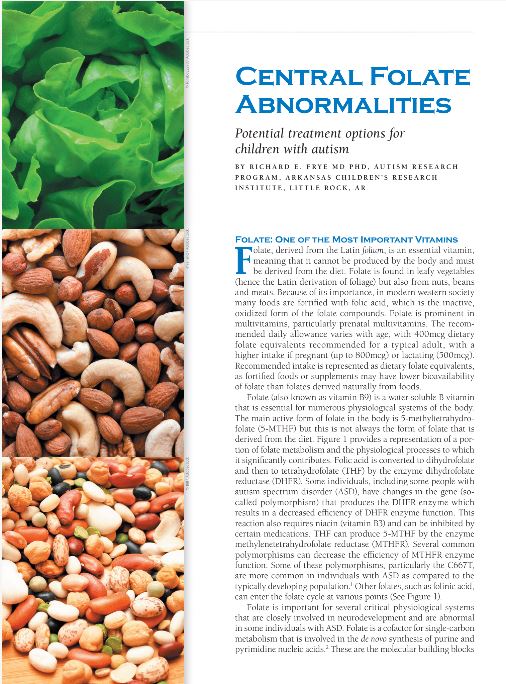
Central Folate Abnormalities
Seizures and ASD
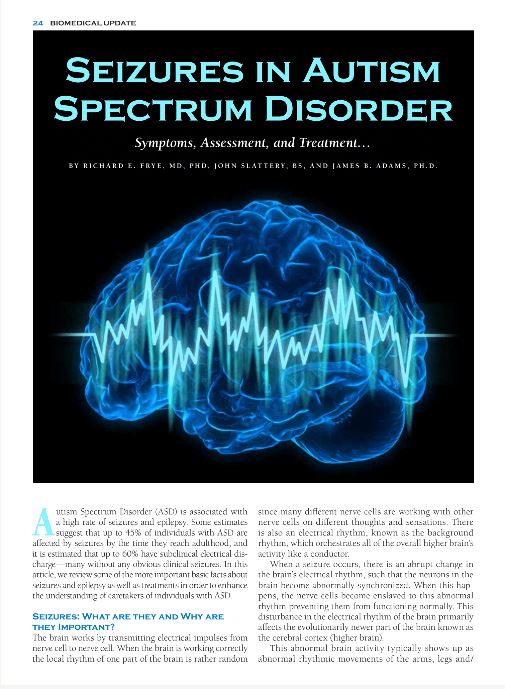
Seizures in ASD
Cerebral Folate Deficiency in ASD
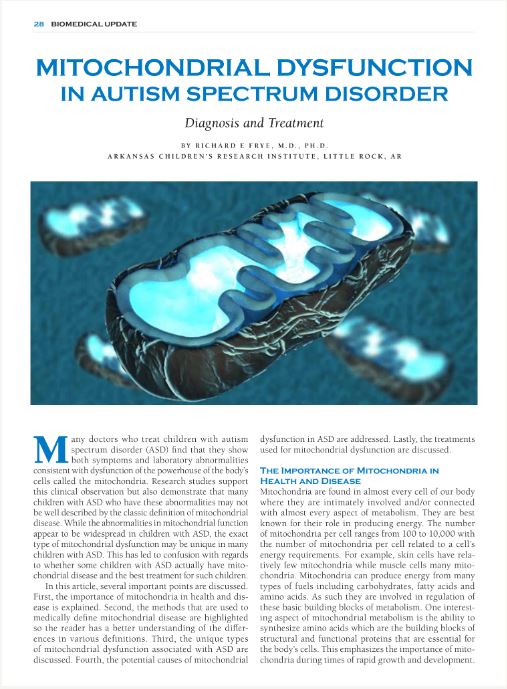
Mitochondrial Dysfunction in ASD
Mitochondrial Dysfunction
Beyond Behavioral Evaluations
The Healthy Child Guide
Explore Topics
Understanding the research
Click any topic to learn more about the science — then follow through to the full collection of articles.
Cerebral Folate Deficiency
Folate receptor α (FRα) autoantibodies (FRAAs) are prevalent in autism spectrum disorder (ASD). They disrupt the transportation of folate across the blood-brain barrier by binding to the FRα. Children with ASD and FRAAs have been reported to respond well to treatment with a form of folate known as folinic acid, suggesting they may be an important ASD subgroup to identify and treat.
Link to ArticlesEnvironmental Influences
Genetic abnormalities in ASD are widely accepted; however, recent studies point to an equal contribution by environmental factors, particularly environmental toxicants. New publications examine estimated toxicant exposures during the preconceptional, gestational and early childhood periods, look for biomarkers of toxicants, and examine potential genetic susceptibilities.
Link to ArticlesEpilepsy and Seizures
Seizures are very common in individuals with autism, as are abnormal EEG recordings with seizure-like activity. A diagnosis of epilepsy is found in up to 40% of children with autism and, in many cases, is refractory to treatment. The pathology that causes epilepsy has also been implicated in children with autism.
Link to ArticlesImmune Dysfunction
Recent studies suggest ASD is associated with immune system dysfunction. Inflammatory cytokines are often elevated in the blood and brain. Children with ASD sometimes have autoantibodies to brain tissue as well as non-brain tissue such as the folate receptor alpha (FRα) and mitochondria. Another area of interest is the overlap between ASD and PANDAS/PANS.
Link to ArticlesMetabolism & Biomarkers
Autism is associated with an imbalance in glutathione-dependent redox metabolism, linked to folate and methylation metabolism. Together these abnormalities define a distinct ASD endophenotype closely associated with genetic, epigenetic, mitochondrial, and environmental factors. Biomarkers reflecting these abnormalities are being investigated to better understand the mechanisms underlying ASD and to guide new treatments.
Link to ArticlesMicrobiome
Increasing evidence suggests the enteric microbiome plays a critical role in the etiology and symptomatology of ASD, at least in some cases. Dr. Frye’s team has investigated novel approaches for studying and manipulating the enteric microbiome to improve autism symptoms, including the clinical and basic research aspects of enteric microbiome metabolites on mitochondrial function.
Link to ArticlesMitochondrial Dysfunction
Abnormalities in mitochondrial function appear to affect a significant number of children with ASD, but their nature is poorly understood. Through literature reviews and clinical and basic research, Dr. Frye’s team has found that mitochondrial dysfunction in ASD is distinct from other forms of mitochondrial disease, and has developed a cell-line model to study it in detail.
Link to ArticlesmRNA
Mutations in hundreds of genes contribute to the risk of ASD. Studies show significant differences in ASD-associated miRNA expression profiles across tissues (saliva, blood, serum, brain). These findings reveal miRNA–gene interactions regulating critical pathways in neuronal proliferation, immune cell death, and neuronal development — a promising area for future discoveries and possible treatments.
Link to ArticlesNeuroimaging
Neuroimaging has uncovered connectivity abnormalities in the brains of individuals with ASD. Functional MRI and other advances may have clinical utility as non-invasive ways to investigate neurochemical alterations, providing dynamic insight into the brain’s functional organization and helping evaluate treatments for patients with ASD and other neurodevelopmental disorders.
Link to ArticlesTreatments
Although the prevalence of ASD continues to rise, no effective medical treatments have become standard of care. As the pathophysiological abnormalities associated with ASD are studied, treatments targeting neurotransmitter imbalances, sleep onset disorder, and metabolic abnormalities in folate, cobalamin, tetrahydrobiopterin, carnitine, and redox pathways are being investigated — along with treatments for epilepsy, mitochondrial and immune disorders, and the enteric microbiome.
Link to ArticlesBrowse by Resource Type
More ways to explore
Videos & Presentations
Publicly available video-recorded presentations and interviews.
Watch VideosPodcasts & Audio
Radio interviews, podcasts, and audio versions of articles.
Listen NowResearch Articles
Articles, abstracts, and full-text journal publications (when available).
Browse PublicationsPatient Stories
Published stories featuring Dr. Frye’s patients and their journeys.
Read StoriesNews & Media
Stories about Dr. Frye’s research published across media outlets.
Read NewsClinical Protocols
Laboratory testing and treatment protocols. Please consult your physician before making medical decisions.
Learn MoreBook an appointment
If you’d like to book an appointment for your child — or have your child’s primary care physician reach out — Dr. Frye’s office is here to help.